
Centro Flor de Toe
Atmosphere
Features
Atmosphere and feature ratings above are based on Best Retreats research (October 2026). They will be updated if Centro Flor de Toe submits its own information.
Centro Flor de Toe: An In-Depth Review for Retreats near Tamshiyacu, Peru
Status note (October 2026). Centro Flor de Toe’s website, centroflordetoe.com, no longer loads: the domain does not resolve. The last archived copy, captured by the Wayback Machine on November 13, 2025, still advertised group retreats. Its Retreat Guru page is still online but lists no programs, guides or reviews. We could not confirm whether the center is still operating. This profile draws on the center’s archived website, captured between July 2023 and November 2025, and is kept as part of our archive.
Centro Flor de Toe is a small, family-run shamanic center in the Peruvian Amazon, about an hour by boat from the river town of Tamshiyacu, south of Iquitos. It was led by a married healer couple, Anael Rojas Rodríguez and Rosa Tangoa, and sold 8-day all-inclusive retreats with four ayahuasca ceremonies for €1,000, along with longer master plant dietas. It never built an independent review record: we found no ratings on any platform and no press, and the only guest feedback is five testimonials on its own site. We found no incidents. The concerns are the lack of any independent check, a remote boat-only location with no published safety measures, a program that included liquid tobacco, and a name that refers to toé, a toxic plant sometimes added to ayahuasca. Our earlier profile also needs correcting on the healer’s name, the legal position and several details.
🎯 At a Glance
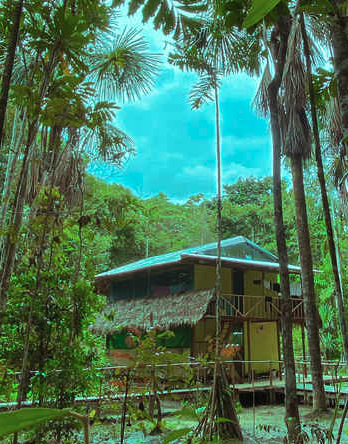
- Locations: About one hour from Tamshiyacu, in Fernando Lores District, Maynas Province, Loreto, Peru, reachable only by boat on the Amazon River, according to the center’s archived “Nosotros” page. Tamshiyacu is about an hour by speedboat upriver from Iquitos, per Wikipedia. The exact site is not published.
- Approach: Traditional Amazonian healing in the healers’ own home environment, “outside the modern and technological world,” with individual and group dietas, ayahuasca, ojé purges and kambo, according to the archived site. The center described itself as a spiritual center “far from being a tourist space.”
- Suitable For: Experienced travelers who want a basic, traditional dieta with a local family, speak some Spanish, and can accept a remote site with no published medical or emergency arrangements. Not suited to first-timers who need screening, medical support or an independent track record.
- Costs: €1,000 per person for the 8-day group retreat, including lodging, food, ceremonies and transfers from Iquitos airport, according to the archived homepage. Flights to Iquitos and travel insurance were not included. Longer dieta stays were offered at unpublished prices.
- Overall Assessment: A low-cost, traditional family center with no independent reviews, no published screening or safety policy, an offline website and a remote location. We cannot recommend booking without direct, written answers on safety and on what is in the brew. Directory evaluation: C.
💬 What Guests Are Saying
Here is how Centro Flor de Toe rates across review platforms in October 2026:
| Platform | Rating | Reviews | Notes |
|---|---|---|---|
| Retreat Guru | None | 0 | Identity-verified page with no programs, guides or description |
| Center’s own website (archived) | n/a | 5 testimonials | Dated March 2023 to December 2024; curated by the center |
| Tripadvisor, Google, BookRetreats, AyaAdvisors, Trustpilot, Facebook | Not found | n/a | No listings surfaced under any spelling |
The positive picture. The five testimonials on the center’s site, written in Spanish, French and English, are warm. One guest who first came for a week out of curiosity returned for two weeks of dieta and ayahuasca and calls the experience a true diagnosis of what was wrong inside; the guest admits the dieta was hard, especially the nights. Another describes a 30-day stay as the most precious of their life, after arriving depressed. Several thank Anael, Rosa and their family by name for their warmth.
The negative feedback. None found. With no independent reviews anywhere, that tells you very little.
Who is writing the reviews. All available feedback was chosen and published by the center itself. Our earlier profile said guests called it a “soul journey,” attributed to the center’s website; the site’s own copy calls the retreat “a journey for the brave soul,” so that was marketing, not a guest quote. Our earlier profile also cited praise for the setting on Facebook and a few reviews on Tripadvisor and AyaAdvisors; we found no Facebook page and no listing on either platform in October 2026, so those claims remain unverified. If you have attended, we encourage you to share your experience through our submission form.
🚩 Incident Report
We searched review platforms, Peruvian and English-language news, and legal sources for reports involving Centro Flor de Toe, Anael Rojas Rodríguez and Rosa Tangoa.
- Deaths and serious injuries: None found.
- Sexual misconduct: No allegations found.
- Theft and crime: No reports found.
- Legal action: None found.
Given how small the center’s online footprint is, the absence of reports is weak evidence. If you have experienced or witnessed an incident at Centro Flor de Toe, please report it confidentially.
🔍 Critical Notes
The name and the toé question. Toé is the Amazonian name for brugmansia (angel’s trumpet), a plant that some practitioners add to ayahuasca. Vice reported in 2013 that every part of the plant is toxic and that its use by “pseudo shamans” was spoiling ayahuasca tourism. The center’s archived site never says whether toé is used in its brew or dietas. A name is not evidence of practice, but anyone considering this center should ask directly and in writing.
Liquid tobacco and other medicines. The 8-day package included one session of “tabaco líquido” (liquid tobacco), alongside rapé, sananga eye drops and an ojé purge. Ingested tobacco is a strong traditional purgative, and nicotine poisoning is a real risk at high doses, especially alongside other purges. Ask how much is given, how it is supervised and whether it is optional.
Remote, with no published safety measures. The center is reachable only by boat, about an hour beyond Tamshiyacu, which is itself an hour by speedboat from Iquitos. A 2020 report by Actualidad Ambiental describes Tamshiyacu’s health post and health center and a municipal boat used for emergency transfers to Iquitos. The archived site published no screening form, medication policy, medical staff or emergency plan.
Donations. The site also asked visitors for donations to a social-aid fund, to sponsor primary school children and for reforestation. No registered charity or accounts were named.
The legal position. Peru’s National Institute of Culture declared the traditional knowledge and uses of ayahuasca part of the nation’s cultural heritage in 2008, as the state news agency Andina reported, while distinguishing them from commercial, decontextualized uses. Peru has no licensing system for retreat centers. Our earlier profile called the legal status “ambiguous,” which understated that recognition. See our country-by-country legal guide.
Corrections to our earlier profile. The female healer is Rosa Tangoa; our earlier profile called her “Pink Tangoa,” an apparent mistranslation of Rosa. The “1,000” on our earlier page was the €1,000 retreat price. The description of a “tranquil mountain retreat” was placeholder text: the center is in lowland Amazon rainforest. Our earlier profile’s “clean online reputation” overstated things; the center has almost no independent online presence at all. Retreat Guru’s amenity checklist for the center (pool, spa, air conditioning, fitness center) appears to be unedited template data and does not fit a boat-only jungle site.
🆘 Screening & Mental Health Risks
We found no published screening process, health questionnaire, contraindication list or medical staff. The archived site says the shaman talks with each guest about their problem and recommends a dieta and ceremonies, and the package included a private talk with the shaman, a private “therapeutic” talk and a group integration talk; no therapist is named. The site promoted ayahuasca for depression, anxiety and post-traumatic stress, and said Anael Rojas treats people with mental, physical and serious illnesses, which makes the absence of screening more concerning. ICEERS notes that ayahuasca’s MAOI component makes combinations with SSRIs and other serotonergic medications contraindicated, and that ayahuasca is contraindicated for people prone to psychosis. Erowid warns of extreme, possibly fatal reactions with some prescription drugs. Kambo has its own serious risks. Ask what screening is done, which medications are excluded and how a medical emergency would be handled from a site this remote. Never stop a psychiatric medication to qualify for a retreat without your prescriber’s guidance.
🧪 Brew Substance
The center did not publish its ayahuasca recipe. Traditional ayahuasca combines the Banisteriopsis caapi vine with a DMT-containing leaf such as chacruna, as Erowid explains; whether toé is ever added here is unknown. The 8-day package listed four ayahuasca ceremonies, one ojé purge (a latex from the ojé tree used as a purgative), one sananga eye-drop ceremony, one rapé session, one liquid tobacco session, a flower bath, a sacred clay session and a massage. Dietas used master plants the site names as chuchuhuasi, cat’s claw (uña de gato), turmeric and “requia.” Kambo was offered as part of individual treatment plans. Ask exactly what is in each cup and how doses are set.
📍 Location, Setting & Style
- Setting: A riverside jungle property about an hour from Tamshiyacu, a farming and fishing town on the Amazon where cacao, umarí and pineapple grow, according to the center. Tamshiyacu is hot and very wet, with average highs of 30 to 32 °C, per Wikipedia.
- Style: Traditional and family-run. The center described dietas carried out the way Amazonian healers did them centuries ago, in the setting where the healers themselves live. It also offered shamanic apprenticeships, flora and fauna learning, jungle excursions, therapeutic massage and a shop selling local crafts and plant products. Dinner was not served on ayahuasca ceremony days. The website was in Spanish.
- Rooms: Not described on the archived site.
Practical guidance: Fly into Iquitos (IQT). The center said it provided transfers from the airport to the center and back; the trip involves road and river travel to Tamshiyacu and then a further boat ride. Confirm the transfer arrangements, and who pays for an emergency evacuation, before you go.
Should You Book?
Centro Flor de Toe may suit an experienced traveler who wants an inexpensive, traditional dieta with a local healer family and is comfortable with very basic conditions far from medical care. But its website is offline, it has no independent reviews, and it published no screening, medication policy, medical staff or emergency plan. Its program included liquid tobacco, and its name refers to a toxic plant whose use it never addressed. If you are considering it, first confirm that it is still operating, then get written answers on screening, what is in each brew (including whether toé is used), how tobacco and kambo are given and supervised, and how a medical emergency would be handled. Read our guide to verifying retreat facilitators.
The Team & Story
The center’s archived “Nosotros” page presents two healers. Anael Rojas Rodríguez is described as a “Maestro Shaman” with 26 years of experience in natural medicine, a descendant of the “Achual” people (probably Achuar), who came to healing through ancestral curanderos of the Peruvian Amazon. Rosa Tangoa, his wife, is described as a “maestra shamana” with 32 years of experience, born to healer parents, who began her path after an illness that medicine could not explain. Guest testimonials suggest a wider family helps run the center. No founding year or legal entity is published; the site’s content dates from early 2023. We found no independent trace of either healer. We did not independently verify anyone’s credentials.
Prep & Integration Tips
Before you go: Confirm that the center is operating and get its current contact details, since the website is offline. Disclose every medication and health condition, talk with your own doctor well before the retreat, and ask about the dieta’s food restrictions. Buy travel insurance that covers evacuation from remote areas. After you return: The package included one group integration talk, and no ongoing support was described. Arrange support from a qualified therapist at home. Our guide on how to research ayahuasca incidents can help you check any center.
Pros & Cons
| Pros | Cons |
|---|---|
| Low all-inclusive price of €1,000 for 8 days | Website offline; current status unknown |
| Traditional dietas with a local healer family | No independent reviews on any platform |
| Airport transfers from Iquitos included | No published screening, medical staff or emergency plan |
| Warm testimonials on its own site | Remote and boat-only, two or more hours from Iquitos |
| No incidents found | Liquid tobacco in the program; never said whether toé is used |
Book Your Ceremony
The archived site took bookings by WhatsApp and email, with the phone number (+51) 942670111, and listed group retreats from July to December at €1,000 per person, without stating the year. The website is now offline and its Retreat Guru page lists no programs, so confirm that the center is operating before making any payment. Then get in writing what is in each brew, how tobacco and kambo are supervised, the emergency arrangements and the cancellation terms. Best Retreats does not take bookings; learn more about our mission.
Last reviewed October 2026.
This article is for informational purposes only and is not medical advice. Consult a qualified medical professional.